
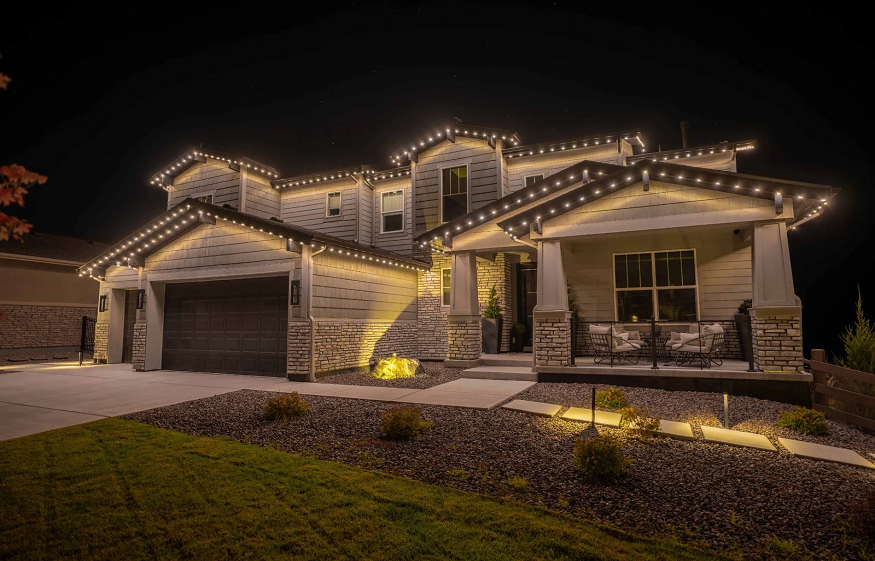
Walk through the average modern home and you’ll find a remarkable amount of intelligence baked into the walls. The thermostat learns your schedule. The locks recognize your phone. The doorbell streams video to your wrist. The speakers respond to your voice from across the room. Lights inside the house dim themselves at sunset and the robot vacuum runs while you’re at work. By any reasonable measure, the interior of a 2026 home is a connected ecosystem.
Then you step outside and the technology stops. The porch light is still on a manual switch or, at best, a $12 dusk-to-dawn sensor from the hardware store. The Christmas lights, if you bother with them, are plugged into an outdoor outlet on a mechanical timer. The landscape lighting is a separate system from a separate company that you probably can’t even control from your phone. The exterior of the home is, technologically speaking, still living in 1995. That’s the gap permanent outdoor lighting is starting to fill — and companies like First Response Lights are installing systems that bring the same kind of always-on, app-controlled, schedule-aware intelligence to the exterior of the house that homeowners have come to expect inside it.
If you’ve been adding smart devices to your home one at a time and noticed that the outside has been left out of the upgrade cycle, here’s why permanent lighting is the natural next step.
What “smart” actually means for the exterior
A permanent outdoor lighting system is, at its core, a network of low-voltage RGBW LED nodes installed in a slim aluminum channel under the eaves. That’s the hardware. The interesting part is the controller. Each system ties into your home Wi-Fi and runs through a manufacturer app that handles scheduling, scene management, and automation.
Read More: Save Big When You Buy VintageView Wine Racks Online
Once it’s installed, you stop thinking about it the same way you stopped thinking about your smart thermostat after the first month. The lights come on at sunset — not at a fixed clock time, but at actual sunset, recalculated daily based on your latitude. They turn off at whatever time you’ve set. They handle daylight savings on their own. If you’re traveling, you don’t need to do anything; the schedule keeps running. If you want to flip the whole exterior to red and green for Christmas Eve, that’s three taps from your phone.
This sounds small until you compare it to the alternative — the annual ritual of resetting mechanical timers, replacing the bulb in the dusk sensor, and pulling the Christmas lights out of the garage. It’s the same kind of “I can’t believe I used to live without this” upgrade that smart thermostats were ten years ago.
Where it integrates with the rest of your smart home
The better systems on the market — names like Jellyfish Lighting, Trimlight, and Govee are the ones most homeowners run into during research — increasingly play nicely with the rest of the connected home ecosystem. Many support voice control through Alexa or Google Home, so “turn on the exterior lights” becomes a command rather than a tap. Some integrate with routines, so the lights can come on automatically when your smart lock detects you’ve arrived home, or when your security camera detects motion in the driveway after dark.
A few homeowners use them as a security layer, scheduling the exterior to flicker or shift colors in a “presence simulation” mode while they’re traveling. Others tie them into smart doorbell events — a delivery driver triggers a brief brighter setting at the front entry. The integration depth varies by brand, so if smart home tie-ins are important to you, ask specifically about which platforms a system supports before you sign a contract.
Read More: When the Water Stops Flowing: A Practical Guide to Well Pump Repair and System Health
Things to know before installing
A few practical points worth thinking through:
The install matters more than the brand. A poorly installed system from a great brand looks worse than a well-installed system from a mid-tier brand. The thing to look for is whether the aluminum channel disappears under the drip edge during daytime. Sloppy installers surface-mount it onto the fascia, which leaves a visible strip of hardware on your home‘s exterior. Always ask to see daylight photos of completed projects, not just glamour shots taken at night.
Wi-Fi reliability matters. Because the system depends on your home network for scheduling and control, weak Wi-Fi at the perimeter of the house can cause dropouts. If your garage or eaves are at the edge of your router’s range, you may want to add a mesh node or extender before the install rather than after.
Plan around other exterior projects. If you’re going to repaint the fascia, replace gutters, or redo the soffits in the next year or two, get those done first. Installing permanent lighting and then tearing it back down for another project is exactly the kind of money-burning sequence that makes homeowners regret the order they did things in.
The everyday mode is the point. It’s tempting to imagine you’ll be running color shows constantly. In practice, almost every homeowner settles into using warm white the vast majority of the year and saving the colored modes for actual holidays. If the warm-white architectural look isn’t appealing to you on its own merits, the system probably isn’t the right purchase.
The bottom line
Smart home upgrades tend to follow a predictable arc: thermostat, locks, doorbell, speakers, security cameras, then a long pause where homeowners run out of obvious things to upgrade. Permanent outdoor lighting is the upgrade that breaks that pause. It brings the exterior of the home into the same connected ecosystem as everything inside it, and once it’s installed, going back to manual switches and mechanical timers feels about as appealing as going back to a non-programmable thermostat.
For the homeowner who’s already invested in making the inside of the house intelligent, leaving the outside on a dumb switch is starting to feel like an oversight worth fixing.